
BARBARA A.
HOLLAND.
CRISES OF REJUVENATION.
30th ANNIVERSARY EDITION.
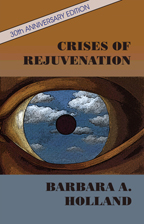
The complete poetic
cycle, Crises of Rejuvenation, originally published in two
volumes in 1973 to 1975, is now expanded and annotated by Brett
Rutherford. Most of the works in this collection are inspired by
paintings of the Belgian surrealist Rene Magritte, and the notes
explain the precise connections between the writings and the paintings. Those
who heard Holland read in New York still remember some of the haunting
works here, including "An Abominable Breakfast," "My Old Friend, the
Sorcerer," "High On Three Cups of Tea," and "The Inevitable
Knife." Also here are the Wagnerian yearning of "Not Now, Wanderer,"
and the Ray Bradbury tribute, "Autumn Wizard."
This single-volume print edition of
this enduring poetic cycle from the 1970s is available now. ISBN 0-922558-20-5, 106 pages, paperback. $14.95. CLICK BELOW TO ORDER FROM AMAZON. Or, purchase the PDF ebook for $2.00.
FROM BRETT RUTHERFORD'S INTRODUCTION:
What is surrealistic in the context of these poems? Magritte’s work differs substantially from what I shall call, for lack of a better term, the work of “hard” Surrealists. He poked fun at manifestos and nearly always rooted his paintings in reality. Where a Dali landscape is often completely alien, and where other modernists even abandon traditional representation altogether, Magritte’s paintings depict the strange and inexplicable in a realistic, painterly manner, centering on the cityscapes and landscapes of Paris, Belgium, the European forest and countryside, mountains and seashore. Rows of town houses line up in tedious splendor, their windows reflecting or capturing proper clouds. Magritte’s sea and sky are photographically perfect, except when intruded upon by interloping impossibilities.
In “The Empire of Light,” for example, the artist presents a house, a garden wall, some trees and a street lamp. The lamp casts light and shadows out over the lawn and it is reflected in a pond. All is dark under the trees. An ordinary, realistic scene, depicted with amazing subtlety in the gradations of tones of light on the underside of the trees. The element of the Surreal enters when we look at the sky above the scene. It is bright, noontime blue! The scene below is night, above is high noon. The pond, of course, should be blue as the sky, and the trees should be lit from all directions by refracted sunlight. Magritte blends the underlit trees and their foliage into a silhouette against the blue sky, a masterpiece of illusion. The observer knows that something is “mysterious” or “wrong” about the painting, but its photographic realism fools the eye. Other Magritte paintings are more blatantly Surreal. An eye stares out of the center of a slice of ham. Three moons perch in the limbs of a tree. An eagle hatches out of a jagged mountain peak. Household objects and a lion litter the edge of a road.
Magritte admired mystery stories about secret agents, and was fascinated with the works of Edgar Allan Poe. He created a visual world in which mysterious objects, such as little round sleigh bells, French horns, lions, and bowler hats, appear again and again on beaches, in forests, or in city streets. Or, a familiar room and its objects are petrified, or a sky is rendered as a stack of cubes.
This combination of realism and the mysterious makes Magritte unlike most other Surrealists. The same factor makes his work much more accessible to average viewers. There is a special appeal for poets, who are always looking for ways to turn the everyday into the mysterious. Barbara Holland is not a “Surrealist” in the literary sense. There is no randomness, no impulse toward Dadaist fist-shaking. The ambiguities of meaning, the shattering of form and syntax that run rampant in literary Surrealism have no place in her writing. Like Magritte with his photographic style, Barbara writes in plain English, often in a narrative that could easily be read as prose to the unwitting listener with poem-phobia. Her voice speaks in complete sentences, tightly packed clauses, and unambiguous meaning.
The world of Barbara Holland, then, is the real one. The twist is simply that impossible things happen in her world. Roses drink bottled blood, tree stumps sprout human ears, unaccompanied crutches stride the avenues, and a knife appears in the poet’s back as a permanent ornament. She writes with clarity and wit about each brand of impossibility.
How much Magritte does the reader have to know to appreciate these poems? The answer is — surprisingly little. Browse through a book of Magritte’s work to get a feel for the visual world, and you are ready for most of what Barbara deals out. In fact, most of these poems are not specifically about any particular Magritte painting. Magritte merely provides the template that Barbara superimposes over her New York turf. She sees her urban setting as if through the canvasses of the master, and tells us what she sees.
This new edition of Crises of Rejuvenation contains a number of poems which were not in the first edition, eleven of them, in fact. By adding them to this edition, we have captured all the poems written by Barbara Holland during the time she was under the nearly full-time spell of merging Magritte’s surrealism with the hard realities of life in New York.
It is a privilege to bring this masterful cycle of poems back into print at last. These poems have taken nest in my own consciousness, as they will in yours. You will think of them, of their strange and beautiful images. Even better, you will find that certain phrases become a part of your own vocabulary. You may even find that your perceptions are just slightly altered so that you, too, sit down and write about how the real and unreal collide and invade one another’s territory all around you.
The answer to the book’s cryptic title lies therein, doesn’t it? We grow old and die by seeing things only in the conventional way. We are rejuvenated when we can see things through another sense of dimension, when we can use our imagination so that “names and the objects which they had previously owned divorce for other partners.” It may be mad, but it is glorious!
Buy PDF Ebook Now
(To learn more about Barbara Holland and her poetry, CLICK HERE.
Version 21.3 Updated November 29, 2025
History of the Press
Book Listings
Anthologies
- Here There Be Lions
- The Argo Got Away
- Opus 300
- Wake Not the Dead!
- On the Verge
- Group 74
- Meta-Land
- Beyond the Rift
- Tales of Terror (3 vols)
- Tales of Wonder (2 vols)
- Whispering Worlds
Aeschylus
Joel Allegretti
Leonid Andreyev
Mikhail Artsybashev
Jody Azzouni
Moira Bailis
Callimachus
Robert Carothers
Samuel Croxall
Richard Davidson
Claudia Dikinis
Arthur Erbe
Erckmann-Chatrian
Michael Frachioni
Emilie Glen
Emily Greco
Annette Hayn
Heinrich Heine
Barbara A. Holland
- The Holland Reader
- After Hours in Bohemia
- Selected Poems 1
- Selected Poems 2
- Shipping on the Styx
- Out of Avernus
- The Beckoning Eye
- The Secret Agent
- Medusa
- Crises of Rejuvenation
- Autumn Numbers
- Holland Collected Poems
- In the Shadows
Victor Hugo
Thomas D. Jones
Michael Katz
Li Yu
Richard Lyman
Meleager
D.H. Melhem
David Messineo
Th. Metzger
J Rutherford Moss
Denise La Neve
Ovid
John Burnett Payne
Edgar Allan Poe
Suzanne Post
Shirley Powell
Burt Rashbaum
Ernst Raupach
Morton D. Rich
Susanna Rich
Brett Rutherford
- New and Recent Poems
- The Argo Got Away
- Goodman's Croft
- From Hecla
- Big House, Rent Cheap
- Island of the Dead
- Story of Niobe
- The Inhuman Wave
- Fatal Birds
- Pumpkined Heart
- Doll Without A Face
- Crackers At Midnight
- Anniversarius
- Gods As They Are, 2nd ed.
- Prometheus on Fifth Ave
- Things Seen in Graveyards
- Prometheus Chained
- Dr Jones & Other Terrors
- Trilobite Love Song
- Expectation of Presences
- Whippoorwill Road
- Poems from Providence
- Twilight of the Dictators
- Night Gaunts
- Wake Not the Dead!
- Pity the Dragon
- It Has Found You
- Autumn Symphony
- By Night and Lamp
- September Sarabande
- Midnight Benefit St.
Boria Sax
Charles Sorley
Vincent Spina
Ludwig Tieck
Pieter Vanderbeck
Jack Veasey
Don Washburn
Jonathan Aryeh Wayne
Jacqueline de Weever
Phillis Wheatley
Sarah Helen Whitman
Section Links
Featured Poets
- Joel Allegretti
- Jody Azzouni
- Boruk Glasgow
- Emilie Glen
- Annette Hayn
- Barbara A. Holland
- Donald Lev
- D.H. Melhem
- Shirley Powell
- Brett Rutherford
- Jack Veasey
- Don Washburn
- Poe & Mrs. Whitman