THE SYBIL OF GREENWICH VILLAGE...
BIOGRAPHICAL NOTES ABOUT
BARBARA A. HOLLAND
by Brett Rutherford
Photo of Barbara Holland by Peter Fillingham
Barbara Adams Holland was born on July 12, 1925 in Portland, Maine. Her childhood was spent in Doylestown, PA and then in Philadelphia.
Her father was Leicester Bodine Holland (1882-1952), an architect who moved in mid-career to art history and archaeology. For a number of years he commuted weekly from Philadelphia to Washington, where he was Chief of the Division of Fine Arts at the Library of Congress. Later he taught at Bryn Mawr College, and also worked with the Corinth excavations of the American School in Athens.
The poet’s mother was Louise Adams Holland (1883-1990), an archaeologist and academic specializing in the Latin language (her last work was a study of the Roman poet Lucretius). Her other passions were gardening, swimming, and exploring the mountains of the Adirondacks and Tuscany.
An aunt, Leonie Adams, was an esteemed poet, and a one-time Poet Laureate of the United States.
Barbara’s sister, Marian (b. 1927), married an architect and lived in Philadelphia. Her brother, Lawrence Rozier Holland, became a physicist.
Her sister Marian McAllister writes about Barbara’s childhood:
"Barbara was sickly for the first year or two and had little contact with other children.
"She taught herself to read, at first from labels on food packages and ads in trolley cars. By the time she was five she was teaching me, two years younger, to read as well.
"Living within walking distance of the University (of Pennsylvania) Museum, where her father often took her, Barbara developed an interest in other languages, first in hieroglyphics, then in Chinese.
"All three of us went to an old-fashioned "dame school" of some twenty-four children from the University of Pennsylvania community. The single room held "classes" ranging from kindergarten through sixth grade.
"Barbara then attended private schools, graduating from the Baldwin School in 1943.""
Barbara Holland received a B.A, from University of Pennsylvania in 1948, and an M.A. from the same institution in 1951.
Although she had completed all the course work for a Ph.D, she left graduate school without completing her thesis.
She worked in Worcester, MA on a new edition of the Merriam-Webster Dictionary, taught at a college in West Virginia, researched genealogies, and then worked in New York City for a Wall Street brokerage.
Finally, the lure of Bohemia — Greenwich Village — and the life of a poet, became irresistible. With the slender income from a small cache of stocks and bonds, she quit working around 1962 and rented the apartment at 14 Morton Street in Greenwich Village that would be home for the rest of her life.
Her first chapbook publication, self-published and undated, was Medusa, a 20-page stapled booklet. Another collection, Return in Sagittarius, was published in 1965. Another chapbook was A Game of Scraps (1967). A projected volume of her poems with the photographs of Donald Curran apparently did not materialize, but the poems alone appeared in a slender chapbook as Lens, Light, and Sound (1968). Other small chapbooks were Melusine Remembered (1974), On This High Hill (1974) and You Could Die Laughing (1975).
Holland received a Creative Arts Public Service Fellowship in 1974, and during the following year was engaged in workshops and visits with many schools. She was a fellow at the Macdowell Colony in 1976. She read frequently throughout the Northeast at poetry readings, guest-edited two issues of Boston’s Stone Soup poetry journal, and read her work on radio for WBAI, WRVR, WUWM, and WNYC. She recorded for Folkways Records and on broadcasts for Voice of America.
The poet was also involved with The New York Poets Cooperative, a writers’ group founded in 1969. A founding member, she organized and scheduled poetry readings they hosted at St. John’s Church in the Village.
Her greatest success was in the then-burgeoning little magazines, and Holland could boast that her poems had appeared in over 1,000 magazines and publications. She was certainly one of the most-published American poets of the 1970s and 1980s.
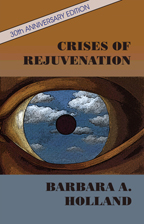
Her association with The Poet’s Press began in 1973 with the publication of Autumn Wizard, a sampler from her long cycle of poems inspired by the surrealist painter Rene Magritte. This cycle, Crises of Rejuvenation, was published by The Poet’s Press, in 1973 and 1974 in two volumes, and remains in print in a single-volume 30th anniversary edition. Other collections of Holland’s work from this publisher include Burrs (1977), Autumn Numbers (1980), Collected Poems, Volume 1 (1980), and In the Shadows (1984).
Another small press, Warthog Books, issued its own “selected poems” collection of Holland’s work, Running Backwards (1983).
Holland’s readings of her poems were from memory, even including her longer dramatic pieces. Audiences were riveted by her performances, whether of the spine-chilling “Black Sabbath,” the self-effacing humor of “The Inevitable Knife,” or the desolate sorrow of “Not Now, Wanderer.” Michael Redmond wrote of her in 1981 in The Newark Star-Ledger, “[S]he is a poet who evades categorization. Her work has been variously described as romantic, mythic, supernatural and surreal; she is as adept at evoking a seascape as in creating a monologue by Medusa. There are city poems, and love poems, and poems both funny and terrifying. The common denominator is her extraordinary imagination, the classical precision of her language, and a wild sense of humor.”
During her last five years, the poet was beset with health problems. She had difficulty reading her work, and her performances were marred by long pauses and memory lapses. After a series of small strokes, her health declined and she spent some time recovering at her sister’s home in Philadelphia. Returning to New York, she died there on September 21, 1988.
Several contemporaneous reviews and essays had acknowledged Holland’s extraordinary gifts, most notably a long review by Stephen-Paul Martin in Central Park (1981), and a symposium issue on the poet in Contact II (1979), but Holland never achieved the fame she richly deserved.
From Reviews of Barbara Holland’s books:
Harlequin and spy, magician and wizard, seer and saboteur -- these
are the roles Barbara Holland assigns to the poet. And in the
nine volumes of her poetry published since 1967 we have come
to apprehend a distinctive voice in American literature. None
of the exhibition and whining self-pity of the autobiographical
school, none of the arrogant self-righteousness of the social
reformers, none of the complacent collecting of self-centered
trivia and effete ironies of the New York school... but a strong,
vivid, often violent voice, shattering complacency with a fine,
rich sense of language and its possibilities...
Invariably, the narrator portrays herself as an outsider,
observant yet selective and active:
What I bring
out of this witch-crazed moment I shall turn
to uses of my own,
rebuild, rewire, reactivate with sound
Here a vision is presented both beautiful and ominous, hinting
at the obscure and irresistible roots of things...
Many of Barbara Holland's wittiest and most brilliant poems
are those of invective and malediction. She neatly carves up
pompous businessmen, fatuous hosts and false would-be lovers.
(The only acceptable lover must, of course, be a demon lover,
Mephisto himself, or something even darker and more primeval.)...
There is an intense yearning expressed in one of the finest
poems to be found in all the collections, "Not Now, Wanderer":
The high howl of my hunger
for you swoops, a lost bird
And yet this seek and search can be fruitful, even in its
unfulfillment:
With this suspense and the concentration
of desire, I make my instrument
of destruction and creation.
If we can speak of a philosophical world view prevailing,
in the poetry, it is a sense of the cosmos as mystery, as inexplicable,
unpredictable, beyond the laws of rationality...
Barbara Holland patron classical poet would be the Ovid of
the Metamorphoses. And her partner in magic and ambiguity
in the visual arts is the Belgian surrealist painter, Rene Magritte...Barbara
Holland's poems often achieve the same effects as Magritte's
paintings...
Few poets writing today can compare with Barbara Holland in
her richness of imagination, fecund with surprising transformations
— and her corresponding verbal ingenuity.
— Robert Kramer in Poets (NY), April 1978
A feminist and an iconoclast, Holland arrived in New York
in 1962 [reading] at St. John's in the Village, McBurney YMCA,
Les Deux Megots and the Cafe Metro. ... Fleeing the claustrophobic
atmosphere of the 'baccalaureate mill', Holland began freelancing
and devoting herself to poetry full-time.
Barbara says, "Poetry was my personal rebellion against
the second-handedness of the scholarly criticism which comprises
doctoral work in literature and the file-clerky business that
it is."
Barbara received a CAPS (Creative Arts Public Service) grant
in 1974. She divides her time between readings in Boston, Baltimore
and New York, guest edits magazines around the Eastern seaboard,
and continues to publish widely in magazines across the country.
I asked Barbara, "Do you write at a certain time during
the day?" She replied, "Never during the day. I wait
until all the crazies have gone to bed and have stopped screaming
at each other and until all the other crazies have stopped using
the elevator, then I write."
—Claudia Dobkins, in Contact II, Spring
1979
Barbara Holland is a master before whom many, or most, if
not all more famous poets should quail.
—Kirby Congdon, in a review of Autumn
Numbers
A true poet of urban romanticism...a seeker of found objects,
to whom the jagged and rusty are mysterious and beautiful...A
major poetic voice from the coffeehouses, off-off Broadway theaters,
poetry jazz readings, lofts, cafes and churches in New York's
literary ferment...A wry romantic.
—Olga Cabral, in Contact II
..wanders through the bleakest wastes of terror and loneliness
without a dram of self-pity...
—David Cunliffe, BB BKs
The Sybil said, "The road to Avernus is easy; the road
of return rough and extremely difficult." Barbara Holland
has taken this road again and again with no difficulty at all.
—Richard Kinter, Maryland Institute of Arts
and Sciences
A new book of Miss Holland's poems is a celebratory event
... the best poems of the collection are characterized by the
surprises of imaginativeness but the logic of the unforced ...
the effect of each poem is cumulative rather than occasional,
their often memorable conclusions not the snappy endings of weaker
authors but inevitable culminations of their poem's energies.
—Martin Mitchell, editor of Pivot
Barbara Holland, the New York City poet of our time, an eccentric
woman of vast writing ability.
—Louise Simons, Off the Wall (National Public
Radio)
From a newspaper interview:
Poet to read her Village verse
by Michael Redmond
In Pennyfeathers, Greenwich Village, the woman who has been
headlined "the most widely published unknown poet in America"
seems to take more pleasure from discussing aspects of Celtic
mythology than from talking about her work.
Although her poems have yet to grace the pages of The New
Yorker — or, for that matter, the three or four other
established publications in which American poets can be said to
"arrive" — more than a thousand literary journals
in the United States and abroad have published her work. These include The New York Poetry Quarterly, The Beloit Poetry Review,
Antioch Review and Voices International.
Eight books of her poetry have been published by literary presses
since 1965. In addition, a number of her poems have appeared in
anthologies published by Viking, Anchor Books (a division of Doubleday)
and Bantam.
Her name is Barbara A. Holland, she has been living and writing
in the Village for some 20 years...
Holland may not have The New Yorker and a fat publishing
contract to boast of, but she does have other sources of recognition.
During the past five years, especially, she has become something
of a cult figure on the New York literary scene (Boston, too),
and she is admired by other, better known writers, such as science
fiction master Ray Bradbury.
Bradbury once wrote to her: "In a world where there are
so many Irving Wallaces and too many Harold Robbinses, are far
far too many Jacqueline Susanns, all duplicates one of the other,
how nice to know there is only one Barbara A. Holland, who speaks
with her own voice and sings her own song."
Although there is only one Holland, she is a poet who evades
categorization. Her work has been variously described as romantic,
mythic, supernatural and surreal; she is as adept at evoking a
seascape as in creating a monologue by Medusa. There are city
poems, and love poems, and poems both funny and terrifying. The
common denominator is her extraordinary imagination, the classical
precision of her language, and a wild sense of humor.
Holland is also recognized as a powerful reader — that
is, her readings are dramatic performances, done from memory;
they have done as much in creating a following for the poet as
the poems themselves.
Concerning the poems: "The content is surreal at times,
but I don’t go and do unusual things with syntax. I don’t
tear the language apart and try to rebuild it from scratch, as
other poets have tried to do ... I don’t think much of ultra-sentimental,
Hallmark Cards type of poetry ... In writing a poem, I use breaks
in the breath rather than grammatical or metrical structures."
Concerning the reciting of poems: "I read mostly by instinct,
but I do have some ideas about performing. I tend to take it very
slowly. If I talked naturally, this would be too fast for most
people’s comprehension."
Holland said she never suffers from stage fright — "even
the time I read for 3,000 rock fans in Boston. They looked completely
unreal to me. But what I have to do is draw back the ego consciousness
and observe myself. I become a stage director; I have this puppet
working for me. So, on Boston Common, I just looked at that enormous
audience and said to myself, ’Well, here you go again.’"
A native of Philadelphia, the poet holds a master’s degree
in English literature from the University of Pennsylvania. She
has been active on the New York poetry scene since the early 1960s
— in Les Deux Megots, Cafe Metro, the McBurney YMCA, and
other poetry centers of the period.
She has since been a featured reader in numerous poetry centers
in New York City and New Jersey, including New York University,
the City University of New York, Fordham University and Fairleigh
Dickinson University. Not to mention libraries, art galleries,
taverns, cafes, lofts, theaters and "a laundromat and a show
store, as well as the parks and piers of New York," Holland
added.
The poet is currently a member of the St. Clement’s Poetry
Festival in New York. Her publisher, Brett Rutherford (The Poet’s
Press), is based, however, in Weehawken [NJ].
From The Newark Star-Ledger, November 10,
1981
Out-Takes Out from an Interview with Barbara A. Holland
October 19, 1981
Pennyfeathers on Seventh Avenue
Greenwich Village, New York City
by Michael Redmond
The following remarks by Barbara A. Holland are taken directly
from Michael Redmond’s hand-written notes, in the order she
made them. Barbara was in good spirits, focused, relaxed, having
enjoyed a good meal.
"In the late Fifties everybody was interested in Eliot’s The Cocktail Party. The funny thing is that they considered
him avant-garde."
"The New York School? Well, what’s left over from
the Beat movement is a rather posh group, including the group
that O’Hara brought together at MOMA, and the Naropa crowd.
They’re doing the circuit — New York is just one of
many places where they touch down. They may have started here,
but now they’re gone Upstate, to New England, or the West
Coast. I’ve never been quite sure how to get on the
circuit."
"I usually mess around in my head with a poem for several
days. I play around with phrases waiting for the subway. One time
I got stuck on the subway going up to hear David Ignatow read
and I got an entire poem done."
"I do base some poems on dreams."
"I admire Marge Piercy, T.S. Eliot, and Dylan Thomas.
I had a lot of trouble eradicating Eliotisms from my work. I don’t
understand about three-quarters of Dylan Thomas, but then, they
say he couldn’t either."
"I’m not sure about feminism, I’m not sure about
the ERA. I worry that the ERA will make women the same sort of
group that blacks became after they got their special legislation.
Then they were driven right back down to the ghetto."
"Poets are the poor relations of literature. They talk
about playwrights and novelists and short-story writers, but never
poets."
"I get rejection slips. They bother me as much as a little
static on the radio. At least I don’t have to deal with people
of the mentality that actors have to."
"We’ve gotten to the point that when poets become
prominent, they become public figures. They may as well be politicians.
"I’m not a joiner. I don’t run with the pack."
"I’m not a ‘political’ poet. But inasmuch
as any writing can be considered a political statement, that’s
the sense in which I can be considered ‘political."’
-end-
Matthew Paris Remembers Barbara Holland (2011)
I met Barbara Holland as a producer of outdoor poetry shows for the Parks Department in the 70s. I was also running hundreds of high schools’ cultural shows in New York, for which I often gladly hired Barbara. Quite surprisingly, she was great with kids.
The 70s for poets was a decade in which there were many diverse strains of verse offered to New Yorkers depending on what spa of verse and what zealous orthodoxy about the direction of poetry one had repaired to. Barbara read anywhere she could, but she could be seen most often in the Village on Barrow street at Emilie Glen’s. She was also no stranger to Westbeth and to poets who lived there like Ree Dragonette.
Ree had turned her home into a duplex arena in which people could read or even give theatrical performances. She was definitely one of the world’s more fearless Bohemians; talking to Ree was an etude in conversing with a woman whom made a moral axiom of never biting her tongue or being discreet about anything. Ree ruled culturally over the poetic scene in Westbeth in the 60s and early 70s. She liked the outrageous. She was very happy with Barbara.
Ree had a way of making her court a realm of comfortable residence for her many lovers. They stayed over after the reading. She specialized in black men. One of her squeezes was Ted Joans. Since she came from a very narrow Italian family form a small town and was brought up to be conventionally Catholic, she was in her feral and feisty streetwise way a fiery champion of all things outre and outrageous. She was also a good poet.
A world of people in their own way as eccentric as Ree was the only realm Barbara could have lived in. Marguerite Young, her close friend, was the only woman I knew in my life who had a home with a carousel in her living room.
Barbara could have only had peers and friends among a delta of urbane eccentrics. She lived herself in a walk up, railroad apartment furnished austerely, apparently at home in its stale and disagreeable ambiance. She had moved from Philadelphia to reside in this Bohemia. She often had lunch with Marguerite Young in Pennyfeathers, a hip restaurant with a counter and liquor license hard by the broad corner of Sheridan Square. Pennyfeathers managed — by what means I could not tell — to maintain the amiable atmosphere of a French bistro.
Like the more aery Marguerite Young, Barbara was never seen with a lover, appeared beyond tawdry erotic consolations, seemed oddly comfortable in her self-made circle of light, enjoying her solarity and egoistic celibacy. Marguerite Young, working at Fordham as a professor, always in the middle of writing a book about Eugene Victor Debs she had added to in subtle lapidary ways to over decades, was a very talkative woman of autumnal social graces who was always insisting that she had had a life in the past of infinite carnal abandonment replete with opiates, orchids, peacocks and nights of unthinkable corruption. Whether any of this was true I don’t know. I can say both Barbara and Marguerite were certainly loners. They didn’t seem to seek out or need people. Barbara would take in Marguerite’s reminisces with what seemed like Dorian silence and her usual arch mask-like look.
Pennyfeathers, where Barbara usually sat for hours on an afternoon nursing a single cup of tepid black coffee, did have its insouciant low level charm. The waiters were cordial. The prices for standard American fare were affordable and they had a few rich cakes and muffins. People dressed weirdly there as if they had fashioned their clothes by hand from a clearance sale in oriental cloths. One felt listening to the table talk that one was among characters out of Tennessee Williams’ plays about Confederate women of an age orchestrating their death. Barbara was often as not sat at the counter rather than at the tables. The vaguely European ambiance festooned with a murky vapor seemed to bring out what social skills Barbara had.
Barbara usually took a place near the back of the counter and with a manner that suggested she was commanding the chef to bring her a truffled steak; she ordered coffee and a simple roll. She had a look on her face as she surveyed the clientèle of what appareled to be supreme contempt, like a female Basil Rathbone, for the denseness of a foul and vulgar tavern on a scurvy hinterlands pallet upon which resided endless legions of louts, savages and purblind lunatics, rife as an army of lobotomized locusts.
I later found out Barbara wasn’t at all a snob though she had come from a Philadelphia Main Line family once. She was just feeling lousy. Qualities of drunkenness, or perhaps a clandestine but fiendish drug use, people attributed to her were actually symptoms of a general inner physical malaise.
The easy style of Pennyfeathers which had become a sort of social gathering spot on a high stereo in the West Village suited Barbara’s own laconic manners and mien of asperity when not performing. On a classic high street where Bohemians going back a long ways had lived with tolerance of geniuses and cranks for close to a century, it had emerged after the settlement of artistic and merely decadent types in the Village had established them there as denizens where the rent was cheap enough to allow one much leisure. Its mock-imperial ethics of an epicurean life without money went back at least as far as the great critic James Huneker. It was, before Barbara Holland and Marguerite Young, the older Village of Edna St Vincent Millay and the seemingly sinister Djuna Barnes. E.E. Cummings and Joe Gould had lived and died there too. During the 40s it was a center of the American classical music scene and anarchist politics, a world of John Cage and his freres stretching to Vigil Thomson’s digs in Chelsea.
I mention these famous names of the day a kind of cultural shorthand; there must have been many thousands of Bohemians who resided there who were mere local characters whose fame didn’t get beyond this real Village. Barbara was at home in such an insouciant milieu. There were reasons. The Village, even into the early 60s, was very cheap. One could live very comfortably in a railroad flat for nearly nothing. Sine it was an old Italian working class small town province, it was also an arena in which nobody asked any questions about one’s private life even before the Bohemians got there.
The poet Edward Field, one who always lived there, has said to me that the Bohemian is a kind of cosmopolite eccentric that more or less died out with the barefoot Jacksonian 60s. They weren’t populists; many of them hated the mob though if they were Reds or anarchists they also loved the rabble in a general vaporous way. They usually dressed in mock formal attire though there was always something wrong or unsettling about how they costumed themselves. The male Bohemians often looked like professors long out of a job. They had shabby suits one suspected they found on the corpses of dead men on the Bowery; they seemed to need a severe haircut. The women were sometimes raffishly dressed in some crepuscular but exotic way that suggested not the real Europe but an exile from Indiana’s idea of a cloudy fictional Europe. These fancy indigenes from a republic of practical inventors and amateur naturalists were themselves not at all repulsed by artifice. All of them almost always had no money and almost none of them had a regular job.
The sexual life was very laissez faire as they say. Many were artists but one didn’t have to be more than decorative and nubile, or uncommonly grotesque if one were not beautiful, to be among them. Artists need courts; there was plenty of them in the Wheelage. People lived there because nobody judged anybody there at least by normal standards although there was plenty of backbiting and gossip. One had a lot of freedom there, possibly because our politicians from our founders and Jacksonian braves onward have always suspected that thought, Art and erotic life is terminally trivial. One also had access to the Italian shops, little cheese markets and tiny but pungent spice emporiums; one could pretend as well that one was living in a vague corner of Ruritania.
The Village was Provencal European if its capitals were always imaginary ones. It detested pioneer America. It was as necessary to the celestial balance of the United States as brothels set next door to churches were in the real Europe.
Barbara didn’t seem strange as long as she didn’t leave the Village. I had thought from the first time I met her she was the sort of eldritch and eerie character as a verse reader that represented as well as anybody I had ever heard the wild and bardic side of poetry. A reading of Barbara’s was scary as a live wail or rant by someone seemingly possessed by demons should be. One really didn’t know what she might do as she intoned her fustian awesome words.
Maybe she could conjure devils and was doing so right in front of one. She certainly always looked as if she had just fasted and sniffed the fetid gasses from geysers of Delphi to achieve the decoction of holy inebriation she offered in her performances.
Physically Barbara was below medium height, had lank hair of an iron grey color that looked as if she had doused it in Canal Street furniture lacquer, a bony face that was skeletal and yet a mauve domino sheathing ineluctable pensees, high Indian-like cheekbones, and a pert small mouth. She seemed emaciated and without muscle tone altogether. She didn’t do anything quickly. Her manner in all things suggested one was being offered impersonally a vague murky ceremony even though one had come into the chamber possibly looking only for the rest rooms.
Whether it was waking or picking up a cup of coffee to sip, all her actions were taken up as if they were part of some Atlantean slow ritual. She wore plain dresses that looked as if she had filched them from 19th century farmhouses, sacking them of dun cloths at midnight. When she spoke in her slurred voice one felt the same lugubrious heaviness about her pithy table talk. She certainly did a lot of listening. What she said was pithy and to the point. She was earnest. She had irony but I never heard her make a joke.
I only discovered later that much of her manner was not from carnal excesses but simple ill health. She didn’t have much money either though her family was rich; they didn’t like her or appreciate her. If Barbara had put off people soporifically, if one could get beyond her weird appearance and style she was very companionable.
Even her strangeness gave her larger-than-life qualities that were oddly attractive. Most of us would not have taken up Barbara’s life, looks and mien. We would have felt too vulnerable. In a curious way Barbara seemed to be strong enough to write the poetry and act it out in all its dour sublimity as none but the most adduces would have dared to do. I always had the sense that she felt she was for the ages. She seemed already veneered with resins in the Egyptian manner as though she were always ready to be instantly interred by the critics whomever they might be or the divine whim of the gods. One imagined her near the cup bearers if Zeus were in the mood to be terrified.
Though I spent a great deal of time with Barbara both professionally and socially I never had a heart to heart conversation with her. I don’t know whether it was because she was older than I was or seemed unthinkably older. I always found myself talking more than I usually do because Barbara didn’t say all that much. She saved her worlds and charismatic energies for her performances. Away from the microphone she often seemed wan, tired and exhausted in a mysterious way as mediums do when the afflatus leaves them. Professionally, unlike such more conventionally occult folk, Barbara was totally reliable, never missed a performance, was there on time, was indifferent to money and under the worst circumstances for a reading never gave less than her frighteningly awesome best.
She was, for a great wordsmith and actress, oddly laconic about poetry, other poets, writers, Art. She never at all spoke to me about politics. It was clear from her verse that she had read very widely and deeply to get her craft and her words, that she had some sense of herself as a poet who embraced the psychic powers of the feminine; she probably admired poets like Ann Sexton and Vachel Lindsay. These are all my assumptions. I don’t see how else she arrived at her persona and offered the great talents she had.
Yet very surprisingly to me, when Barbara was in front of high school students she was very affable, generous with her talk, and ran a class beautifully. When she had to perform in any citation she always did it well.
As I write this a quarter of a century later I still think Barbara is a major lyric poet who has yet to be discovered. I would place her with such wild women as Anne Sexton and Sylvia Plath. Barbara never had the political skills of either of these excellent scary bardic poets. She was much saner than both of them, but less ambitious. Barbara didn’t seek anybody out, didn’t look for courts for wordslingers, wasn’t trying to figure out how to get into this or that magazine or journal, never worrywart about making sure people noticed her when she shooed up for a party. Other people did some of these things for her. One way or another, everybody was very aware of Barbara Holland in any chamber.
When Barbara read she was not a scribe displaying her literacy but a feral actress. Some poets look down at their pages of verse and read dully. Perhaps they hope to suggest they are offering wisdom and morals in a quasi-religious setting where boredom is one of the signs one is luckily in the presence of the ethical and wise. Other poets use the specter of the printed work as a prop in a kind of Emlyn Williams visual act. Barbara had memorized all of her work. She had a slow style of intoning her phrases to help her when she occasionally fished for the next line of her scathing and yet dourly sublime verse. She was in this way a throwback to the Lemurian poets of millennia ago.
A Barbara Holland reading was unforgettable; she understood the art of performing can be if one chooses to terrify people one akin to calling up monsters or the dead. The experience of a Barbara Holland reading wasn’t unlike the spasm of panic one gets when one is walking thorough a mine field shivering or wandering through a gaggle of paranoiac lunatics in an insane asylum. This isn’t to say that Barbara was at all nuts. One can’t do this unless one is somewhat detached from it. One also can't do it if one is too remote from it. She was able to appear crazy as one of her performing arts. The poems on the pages warned that fearful.
I’m not sure how she composed poems; I suspect she strung phrases together she had thought of first as spoken rhetoric, hearing her own voice intoning them in her head. Her verse didn’t attempt to make extension of ideas or intellectual measure her trump. She was the poet of the unthinkable subject, the eerily music phrase, the saturnine pithy line that summed up the furniture of nothingness in a moment. Her poems are rarely more than a page or two. She knew when to get off the stage.
The day Barbara died I had scheduled an outdoor event for her at the Brooklyn Heights promenade. Barbara was always early, prepared and focused at any reading she did. This time she didn’t show up. I knew she had expired. I just waited for the bad news to come my way.
Remembering "The New York
Poets Cooperative"
Ronald Hobbs, now a San Francisco poet, was active in the New
York poetry scene when Barbara Holland first arrived in New York.
Mr. Hobbs writes:
[Barbara] and I, my roommate William J. Matthews and my ex,
P.K. Volmuth, first conceived the idea of the original "New
York Poets Cooperative" in my apartment on Elizabeth Street.
Barbara brought in Donald Lev and Emilie Glen, I think, and Sabina
Jaycna Roseman. There may have been others, it has been so long
ago that I forget, but essentially all of those names belong
together at the same time. Barbara and I performed together frequently
in New York. I think that the cooperative might have lasted five-ten
years maybe before it ran out of steam, Roseman worked at St.
Johns in the Village, so we read there. Matthews and I published
a small mag called SANSKARAS for a few years.".
–
POEMS FROM SANSKARAS MAGAZINE 1968-69
IN THE EYE OF NOON
You,
brother
in solitude,
seated on a lotus
with the moon in your hand!
Coward I must have been
before my body got me
and made it palpable
in cling of flesh
to life brink of Samhadi,
its swift drop downward
into timeless all and nothing
which I dare not know
and yet desire.
A heft of longing
leans to it, yet tenses
to neural probe.
I would be brave
under the splendid swing of arc,
beneath the keystone,
under the curve of arm and lifted thigh
of Nataraja
frozen to stance of mudra
in the eye of noon,
yet could not,
with the wrinkling of this fear
beneath my skin
maintain it and be safe
as long as gnat bite.
Safety locks me up,
casts me in bronze, immures me.
I would be done with it and send
the remnants of its sheath
in droplets, shedding
globules of grief in token of my being
down aching curves of wanting
into God who waits,
but never reaches me quite nearly;
away from God who calls
from shelter of my flesh for contact
with that against which flesh is barrier:
the all consuming Self.
I must not be uprooted, yet must fall.
I fear the plunge and petrify,
run through with veins of screaming gold.
You,
brother
in immobility, refrain
from reaching out to help me,
for my fear of God
who leaps to sunburst from your touch
will be that one decisive
and most wanted shock
that must unlock my terror
and release me, the one
decisive and most wanted shock
that must unlock my terror
and release me, the one decisive
and most puissant fear of all:
its outcome in desired disaster.
You,
brother
in solitude,
seated at fulcrum,
can you understand the ways
of God who slits the iris
of the eye of noon
through which I see you
and defend me?
SHOULDER-HANGING HAIR AND BOOTS
Here he comes tinkling
with a bell snarled in a chain
from which a crippled Crucifix
competes with a medallion
of Yin and Yang, the Mogen David
and the thick set sledge.
He thinks a jingle of loose change
and keeps his eyes obliterated
by the snake on stilts. Nimble
his finger on the long loop
of his beads, slack abacus
that tallies up his prayers.
Quaint storm wit flecked with rain,
a windy will, now here, now there
among the curious, among
those whose bruised hope dangles
from their crooked crosses, hangs
from the sly grin soaring
through the tufts of trees:
a moon quirk of a mouth that moulds
the mantra mount of dollars,
multiplies, dots decimals on gainful nights
when squalor sold for hundreds
and the weekday mind
squirmed in the wooly cubicle
and sloughed its meagre pay.
CRISIS IN STORAGE
Barbara A. Holland
In crossworlds caught at crisis, timelessness
of two dimensions deepening to time drives words beyond
the flatness of a photograph between
the start and full stop of a sentence caught
in an onwardness continued through eternity.
We meet the crux of crisis on a warehouse shelf
kept in an endless speaking and persistent motion graded
throughout successive grays beyond
prohibitives of surface for no ear, no eye,
no motive lifting stillness from the distances.
How shall we share with others in the voice that calls
from cubic growth of breathing, peeling plane from plane?
Lens, light and sound have caverned up a firmament
and no one is allowed to know how vast it is.
FOG
Foghorns bring the loneliness of seas
up the empty street and leave it there
hung out to catch you.
These poems first appeared in 1968 and 1969 in the little
magazine Sanskaras,
published by William J. Matthews and Ronald Hobbs. Thanks to Ronald
Hobbs for providing the copies.
CLICK HERE TO READ POEMS FOR AND ABOUT BARBARA A. HOLLAND